Sunday, August 26, 2012


Thursday, February 26, 2009
Watching the WORDS go by
This post is a mental mash-up of the content of two URL's.

So machines, especially the page ranking system of Google, are parsing our URL text based on statistical relationships. Humans, such as me, enjoy statistical non-narrative representation of URL text as seen on S.I.P. on GAE.
Why doesn't Google create Matrix-like vertical scroll ( MLVS ) of the stream of searches coming through? Or someone write an app that pipes Ettercap packet capturing into a MLVS? Or any other source that would make for an interesting scrolling screen?
I know some of the answers might be "well why don't you write it?". Yes, the Ettercap example is doable by a lone wolf hacker such as myself. But Ettercap is not going to have as rich content as a global Google stream of activity. This is more a business decision than technical. Someone with access to a critical mass of text stream needs to do this.
Wednesday, October 29, 2008
Eschatology, Money Metabolism ,Global SuperOrganism
I am writing this blog entry acknowledging my blind-man's view of an elephant.
Reference materials:- Evidence of a Global SuperOrganism -Kevin Kelly
- The Behavioral Revolution -David Brooks
- Auto-Catalytic Software Development -Joe Gregorio
Along with the three documents above, a fourth reference is this snippet from a friend's email:
Our conversations frequently touch on eschatology (the end of the world) whether it's a religious eschatology like the second coming or a secular eschatology like peak oil, economic collapse or kurzweil singularity. It's interesting how people react differently to an anticipated end of the world regardless of it's precise nature.
Finally there are people who see the ending of worlds as an endless cycle which should be endured rather then fought, escaped or embraced. The old religions: Hinduism, Shinto, Roman and Orthodox Catholicism for example encourage this attitude in many of their adherents, which you can see in the internal politics of India or the apocalyptic science fiction of Japan. I particularly recommend the novel A Canticle for Liebowitz as one Catholic's post-apocalyptic vision of the future.
A key theme in Canticle is the preservation of books (and eventually all knowledge) by the Albertian Order of Liebowitz, and it's implications for the rebirth of technology and long-term survival of the human race. The monks contend that this is what the Church has always done, even though worldly governments and philosphers go through cycles of creation, destruction and reinvention of ideas as well as civilization itself.
I do not have a working articulate synthesis-thesis that ties all the above together, but I do have a bullet list of ideas to popcorn into this dialogue space:
With source code text files being the bedrock of the internet civilization/organism, are programmers standing in the position of Albertian Order of Liebowitz? Or maybe the early free software pioneers at least? Better than Irish monks who preserved Greco-Roman scholastic greatness through the 1000 years of ignorance in Europe, the OSS programmers are preserving text (source code) that moves and operates on itself, which is an order of magnitude higher than the mission of the Irish monks. [ see the auto-catalytic reference ]
If money is the nutrient of the internet super-organism , are the recent global monetary troubles something that could arouse the imperative of self-awareness in the ii? Given D. Brooks opinion that human perceptive abilities are too weak for global investment, the super-organism needs massive global scales of wealth, and humans need the global transfer of information and goods, are we at a crossroads in which humans and the super-organism have a mutual interest and urgency to address that interest? [ see the kevin kelly super-organism reference ]
Extending #2. Will the world's middle and lowest classes see their need of free flowing global information as more imperative than the wealthiest, and see efficiencies gained by the super-organism becoming human's transactional policeman? Will the world's less-than-most-wealthy see the internet transactional civilization of Amazon/Google as their only true savior, rather than Luddite dreams of basal economies ( local and less technology) rising up to rescue their families?
Wednesday, September 3, 2008
Google Chrome
I want to see the OS become the system bus device manager, with the only thing sexy it does is CPU intensive audio visual programs, or some crazy math thing, that read write locally ( and that of course is for professionals or hobbyists ). Beyond that, all the processes anyone gives a **** about are hybrids that have half of a life on the web and half on the local bus. If one was to say "I'm not using the internet today", will effectively be saying "I am just going to be checking if my OS sees all the devices connected on the system bus, and I'll check the memory access speed. Thats all I'm doing today with my computer".
Its time the OS became your plumber, not your mayor.
Wednesday, August 13, 2008
I truly welcome the Computer Overlords
...Where does it end? Sergey Brin and Larry Page, the gifted young men who founded Google while pursuing doctoral degrees in computer science at Stanford, speak frequently of their desire to turn their search engine into an artificial intelligence, a HAL-like machine that might be connected directly to our brains. “The ultimate search engine is something as smart as people—or smarter,” Page said in a speech a few years back. “For us, working on search is a way to work on artificial intelligence.” In a 2004 interview with Newsweek, Brin said, “Certainly if you had all the world’s information directly attached to your brain, or an artificial brain that was smarter than your brain, you’d be better off.” Last year, Page told a convention of scientists that Google is “really trying to build artificial intelligence and to do it on a large scale.”
-Is Google Making Us Stupid?, Atlantic Monthly
Go Google.
Tuesday, June 24, 2008
End of Theory, End of Models, End of the Fuel for Social Justice
I am announcing an end to social critique, at least as the most cutting edge and powerful means of social consciousness. Sure, there will still be millions who spout theories that see colonialism, racism, slavery, and aristocratic privilege as a causal circumstance for current social maladies. But these social theories will be a dialogue for those who can't afford the real analysis, which will be analysis provided by machines uninformed by academic social models. Howard Zinn, Marx, Zerzan, and the KKK are all antiquated preachers selling snake oil explanations of our world.
The person dedicating their life to social justice runs on a fuel of social models and historical interpretation. Social models and historical interpretations are now the backwater. Move the fiery indignation of this Anarchist, and that Marxist, over to the same shelf with the preacher who believes God created all life 4000 years ago. Continue to wave the red and black flags of countercultural dissent, but know your historical coherence is no longer a point of confidence.
All points of confidence come from giant computing processes such as Google. All else is a coherence of lies. The next steps for progress should be the removal of psychologists and social theorists from law enforcement and jurisprudence. Let the machines track the crime [like this], decide the guilty, and assign the sentence. Humans just intervene with their social models and pollute the process. After beta testing in the realm of law enforcement, move on to war and diplomacy.
Below are key concepts and phrases lifted from The End of Theory, and then a link to the article.
No semantic or causal analysis is required.
All models are wrong, and increasingly you can succeed without them.
It calls for an entirely different approach, one that requires us to lose the tether of data as something that can be visualized in its totality. It forces us to view data mathematically first and establish a context for it later.
"This is a world where massive amounts of data and applied mathematics replace every other tool that might be brought to bear. Out with every theory of human behavior, from linguistics to sociology. Forget taxonomy, ontology, and psychology. Who knows why people do what they do? The point is they do it, and we can track and measure it with unprecedented fidelity. With enough data, the numbers speak for themselves."The End of Theory: The Data Deluge Makes the Scientific Method Obsolete -Chris Anderson
Thursday, June 12, 2008
Network Consciousness: The Foundation
Through the 20th century discussions on the feasibility of human-superior AI ( HSAI ) was weighed down by two standard axioms:
- Computers execute commands, and thus are limited to a finite list of commands they are given.
- What computer consciousness there is, is not embodied, and thus can be lost in eternal loops that have little or no corporeal use.
But what about the database query and/or regular expression operating on a global network? Especially within systems such Google and Amazon?
 Sure, the computer(s) still execute a specific action after a conditional statement embedded with the query result. It is in the query that we find the novel. Maybe decades ago the query result set was a less interesting place, with general public network activity so low. Post 1995 Metcalfe's law may make the query result set a much richer place for semantic emergence to occur.
I realize databases or log files have domain specificity built in to the data structures. What is open ended is the endless recombination of these data structures. The novel results of new combinations, fed into more databases structured by the novel data scenario, are then the next source of queries. It is the accumulating layers of novelty recorded, re-mined, and reacted to that is emergent. It should be emphasized that before the cloud computing era, such large novel configurations in corporeal space where sometimes apprehended by conscious beings, but were largely dissipated over time due to no means to record the configuration in strongly bounded language. Historically, the best means was poetry.
Just as animals lack a means to store their cognitions in a strongly bounded language, and retrieve many years after the death of the perceiver, humans have lacked a means to do the same for large social enterprises typical of a global economy. A cloud computing platform with access to a high enough amount of network activity and physical environment sensors can make that evolutionary leap -the cognitive grasp, storage, and reappraisal of global activity.
To turn the tangent of perspective, I'll posit that we already do this to some degree with computers. Financial analysis is but one intuitive example. Across all examples it should be noted the action taken after the analysis is in service to a finite domain of activity -whether financial, crime solving or other. The emergence hits a road block of containment within a government department or private enterprise, the exponential rise of value within the Metcalfe Law hits a terminal point. Terminal points are often death in emergent systems.
A jump start to the Network Consciousness would be a transparent, globally accessible system. Here is the sound of rubber hitting pavement: transparent, globally accessible system with all your purchases and every surveillance camera also. Finally, any computer could mine the data, any person could mine the data. Emergence is back on the table.
It is at this point in my spiel that most people say
"Wow, if there is Network Consciousness, and the Network knows more about what humans are doing than I do, I'd like the Network to be the manager of humans. I think computers would be more fair, and our legal frameworks already do not access human judgement, and are bounded by sequential logic. The Network would probably provide better service than legislatures and courts. I'm for world peace, I'm for the Network ruling humans."
Exactly.
Tuesday, February 19, 2008
Phrases Pointing Forward
Computer-on-a-Planet.
When the network becomes as fast as the processor, the computer hollows out and spreads across the network. -Eric Schmidt.
The next wave of innovation will compress today's parallel solutions in an evolutionary convergence of electronics and optics. It will link to trillions of sensors around the globe, giving it a constant knowledge of the physical state of the world, from traffic conditions to the workings of your own biomachine.
Quotes from The Information Factories -Wired Issue 14.10
Futurism Phrases by Lance:
- All socially usable thoughts are documentable.
- All documents must be readable by the Computer-on-a-Planet.
- All data must have nouns to be considered information, and the nouns can morph over time.
- The Computer-on-a-Planet must intelligently track that morphing.
Add to the above an aesthetic shift. It would be an innovation to move most narrative text to the use of bullet lists, ordered and not ordered. Ordered when algorithms are being discussed ( and by algorithms I include such non-science as "first establish credit, save up a down payment, then bid on a house" ), not ordered when we just know that a given list of things are associated within the bounds of some phenomenon or classification taxonomies. ( It is ironic I used the antithetical paragraph to discuss its successor, the bullet list )
Monday, February 18, 2008
Free water for my Cloudcomputing KEYWORD: GOOD

Ginger Strand has a low-cost op-ed piece presented as expensive hard-nosed investigative reporting in Harper's Magazine, Keyword: EVIL (zoom to blueprint within same article). It is about Google's new server facilities (Codename: 02 Project) located along the Columbia River.
The gist of the article is this: Cloudcomputing is the new telecommunication/computing paradigm, where thinner client machines access web pages powerfully driven by server side processing. Google is the undisputed leader in this paradigm. To lead in this paradigm means Google must build massive server farms that consume equally massive amounts of power. With 02 Project, Google (along with other big industries) is getting use of Columbia River power grid resources for extremely low or no cost.
The article asks us to be upset about this, to call all this Evil. Specifically, the article names these higher order political/economic sins:
Server farms are the new heavy industry, with a given facility consuming city-sized amounts of power.
The Columbia River is providing massive amounts of almost-free government subsidized power via dams.
The article names two Republicans as the deal-maker lever-pullers of the evil secret deals. Pointing to Republicans is political shorthand to arouse suspicion (the Party does deserve this, actually)
Only thing is, CLOUDCOMPUTING IS THE MOST SIGNIFICANT SERVICE MY TAX DOLLARS, OR ALLOCATION OF NATIONAL NATURAL RESOURCES, COULD PROVIDE ME. I am not a money-siphoning politician, nor a higher up in corporate echelons making massive bank on these economic deals. I make the median income in my state, lower than that for my city, and would absolutely love it if our political/economic landscape was tilted towards enabling massive server farms that process for my computing activities.
And for anyone measuring cost/benefits for our poorest, cloudcomputing means lower cost computers, or computer use on cell phones. All that subsidized power for Columbia River server farms can provide computational services to the poor, which is an essential form of empowerment in the 21st century.
Supplemental and supporting material:
Race towards Clean Cloud Computing
Thursday, January 31, 2008
The Last Mile and the Gatekeeper
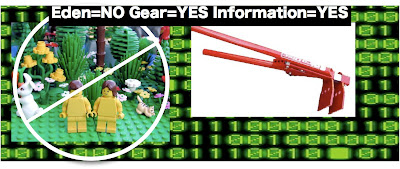
In Judeo-Christian tradition, the first man and woman lived in a place in which no technological solutions were needed, a place with food freely provided and climate appropriate for no use of clothes.
It's a sin to think of the Garden of Eden as a desirable or admirable place. It is stripped of what makes humans special - cognitively generated gear and information that provide survival solutions.
I'm very fastidious when it comes to gear and information. The paradigm of mass marketed dominant brands ( Mall culture ) is not for me, mainly because I find the solutions provide a poor function space for my overall existence. The paradigm of abstinence or less-and-local, whether a Thoreau type of downshifting or militant grown-locally adbusting, is not for me because it is impoverished, self-righteous and not at all healthy.
My highly specific agenda for living has found a perfect meta-tool for life. Google and Amazon. Google ads (with integrated user-targeted news articles) and Amazon recommendations are the only way I want to learn about the gear needed for living. Google monitors almost my entire online life and provides ads relative to my discourse. Amazon provides associative logic on patterns of purchase. With Google and Amazon parsing my online activity, My discourse becomes the gatekeeper/filter for marketing of gear. Gear is good and a sign of a more fully realized human, and with smart ads, the marketing of gear is made good also. Smart advertising combined with long tail economics makes an even more empowering acquisition of goods.
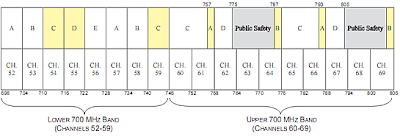
Internet protocol Information travels as electrical pulses called bits. Typically they travel across cables on backbone networks, often one or two satellite hops. Since the 1990's a last mile delivery system of wireless radio signals has become popular, most often in homes or offices as a local area network. With the Federally mandated illegalization of television over the analogue 700Mhz spectrum ( all standard definition TV is now digital, by law ), the internet can be broadcast over old TV signal bands.
This is a new "last mile" delivery solution for information. Remember what makes humans special - cognitively generated gear and information that provide survival solutions. A new last mile delivery of a world wide web of information is a big deal in human progress. Add to that a exponentially more important distinction -the 700Mhz spectrum could be a closed network ( only allowing specific devices, with specific functionalities to access ) or an open network ( you could create your own device, operating system and applications that can access through publicly known standardized protocols ). Google got the FCC to agree that if a certain reserve bid is met, Block C of the 700Mhz spectrum would be mandated as open, no matter who buys it.
As of Jan 31st 2008, with auctioning still going on and winning bidders not known, news emerged that Block C has met that reserve bid threshold, and open access is now mandated. A new step towards more client side economics has been made, in
one of the most powerful pieces of property on Earth.
Monday, January 21, 2008
AI vs AI and the Quantum of the Conversation
This blog post is going to proceed with a fast, bumpy clip. The topics will be:
- Reference to a riveting story on dual asynchronous suicides of two pioneers in artificial intelligence.
- Where their projects have migrated to after their death.
- The Turing Test compared to Shannon's Theory of Information.
- Alicebot vs Google. Introducing my phrase :"The Quantum of the Conversation"
- My wife's question to me: why is AI so important to you?
Wired magazine has an amazingly well written piece by David Kushner titled Two AI Pioneers. Two Bizarre Suicides. What Really Happened?. Not going to repeat the article here, the article does a better job of representing itself. Everything I write in this blog entry assumes you know their work in AI.
McKinstry's Generic Artificial Consciousness (GAC) [pronounced 'jack"] is incorporated into chatbots at http://www.alicebot.org/. Push's project lives on at http://commons.media.mit.edu:3000. Reflecting the essence of the project goal, the websites are interactive, full duplex communication for the visitor.
Both the Mindpixel and Open Mind projects pursue some nuance of the Turing Test (1950), building a machine which appears totally human (in language only) to a human interviewer.
Claude Shannon's Mathematical Theory of Information (1948) is an earliest stage of a comprehensive understanding of all communication via statistical quantification By using Google, a user is showing an interest in statistical quantification of information, because that is all Google searches provide.
Now for my opinion. I would rather have a conversation with Google than Alicebot. Assuming a chatbot friend is not stupid: the bot knows Nixon did not fear an invasion of Visigoths, that leaders in another point in history did worry about Visigoths, and that there are no outdoor alligator farms in Greenland. Still, it is just a single human friend. With Google I get to have a conversation with a real time world information filtering device. WORLD, dear brothers, sisters and chatbots. A chatbot stands in that mode humans usually stand in, socializing. Socialization helps normalize us to be within bounds of behavior and opinion. With a chatbot, just as with single human friends, your normalization is shaped by the quantum itself, which is small and intimate. With Google, your normalization is with an entity much larger than human.
The quantum of the conversation is analogous to the standalone computer versus internet-as-computer dichotomy. Older computer programs were written to happen entirely on one computer, whereas cloud computing programming utilizes multiple computers and usually has access to the whole internet. By another analogy, the Turing Test is flatearth, and a non-human-giant-AI is copernican.
Last night, my wife asked me; "Why is AI so important to you?". My answer: Because of the quantum of our problem domain. All questions, including the most metaphysical or philosophical, have become too complex for humans to understand by talking to more humans. Historically, when we've realized we needed information beyond what other humans could provide we turned to Earth gods or Sky gods. Now the 7th Kingdom of Life, Technology, has grown to measuring all information and giving meta reports, which recursively change the information set. Humans able to get in on that conversation are part of something amazingly powerful. Powerful on a scale with the advent of prayer and community.
Supporting and supplemental documents:

Thursday, January 3, 2008
The Giant AI Series: Cyborg Aggregate of All Human Knowledge: An Interview with Photos
Knowledge and information are the most valuable and sought after commodities for survival. The Google multi-computer brain has mined human knowledge more than any other aggregate entity. All humans seeking to maintain or achieve economic status above peasant-class must be capable of using this all-information tool on a daily basis.
A virtuous civic community featuring a strong associational life is an impediment and harbinger of collective ruin if the members cannot retrieve or post new information online. Association with other humans is still essential for survival, and added to this is association with the world wide web, via its current interface, http://www.Google.com.
The Google multi-computer brain has access to the world wide web mutli-computer brain. The Google machines have gone through several generations.
- Early Stanford Years: 1998
- Sun Ultra II with dual 200 MHz processors, and 256MB of RAM. This was the main machine for the original Backrub system.
- 2 x 300 MHz Dual Pentium II Servers donated by Intel, they included 512MB of RAM and 9 x 9GB hard drives between the two. It was on these that the main search ran.
- F50 IBM RS/6000 donated by IBM, included 4 processors, 512MB of memory and 8 x 9GB hard drives.
- Two additional boxes included 3 x 9GB hard drives and 6 x 4GB hard drives respectively (the original storage for Backrub). These were attached to the Sun Ultra II.
- IBM disk expansion box with another 8 x 9GB hard drives donated by IBM.
- Homemade disk box which contained 10 x 9GB SCSI hard drives.
- Current hardware: 2000-2007
- Servers are commodity-class x86 PCs running customized versions of Linux. Indeed, the goal is to purchase CPU generations that offer the best performance per unit of power, not absolute performance.
- Over 450,000 servers[1] ranging from a 533 MHz Intel Celeron to a dual 1.4 GHz Intel Pentium III (as of 2005)
- One or more 80GB hard disks per server (2003)
- 2–4 GiB of memory per machine (2004)
- Code name: Project 02: 2007-Future
- Google is currently developing a supercomputer at a data center located in the town of The Dalles, Oregon. The new complex is approximately the size of two football fields with cooling towers four stories high.
These have been formative stages of the Google brain. Amongst the world's non-miserable class -a class definable as those with access to global information to inform or empower their mobility, this brain is the most essential ingredient in their classification away from oppression or death. For social justice or political empowerment to occur, some portion of it must have been in the form of a query to the top-tier reference to the world wide web.
This Giant Cyborg Aggregate of All Human Knowledge is uniquely powerful, but not in the same way as power was manifest in early-middle industrial times. This new kind of "Most Powerful" has a core function of dispensing knowledge, which is antithetical to hoarding it within a veil of secrecy.
Oddly enough, this Giant Cyborg Aggregate of All Human Knowledge grants interviews with questions about its presumably secret inner life, and the interviews are granted 24/7 to anyone online.
Interview with Google.com
Question: We have a heard there is a Google Owners Manual. Answer: Question: Tell us more about the secretive Project 02 in The Dalles, Oregon. Answer: Photos: Question: Have you ever been hacked? Answer: Question: This Goolge-Super-AI-Cyborg-Ruling-the-World-Benevolently-Thing, are there others writing about you in this way? Answer:Google speaks to the world in other ways besides a propositional query. The humans in the "company/corporation" sponsor and video record lectures that "do not represent the views of Google Inc" but nonetheless propagate memes via sight and sound. They are called googletechtalks. One lecture connects nicely with the concept of Google as a giant AI. It is titled "Polyworld: Using Evolution to Design Artificial Intelligence", at http://www.youtube.com/watch?v=_m97_kL4ox0.
Supporting and supplemental documents:
http://infolab.stanford.edu/~backrub/google.html
http://citeseer.ist.psu.edu/brin98anatomy.html
Tuesday, December 25, 2007
The Giant AI Series: Why I embraced Cloud Computing
I'm soon to deprecate lancemiller.org. I'm embracing cloud computing totally. Having my own domain, and writing anomalous and unique PHP for it was probably the hip thing to do in the years between 1995 and 2005. Now the street cred associated with running one's own website is often a negative type, due to the millions of spam web URL's out there with useless or malicious intent.
With Gmail, Blogspot, Picasa, and Youtube there is more I can accomplish than with even the best solitary server side hacking style. Even if I managed to write my own equivalence to Google's Ajax powered apps, I would not be plugged inside their platform.
Plugged inside their platform is not just a strange lust to belong to a corporate infrastructure. It has to do with survival through unanticipated calamities. In such scenarios, the resilience of an informational mega-enterprise may fair better than other social constructs. The value of the Google aggregation of data would likely marshal the social resources of know-how and economics for saving it. Also, the economy of scale would work in Google''s favor. All those bits are cheaper to store in mass. Beyond the survival of calamities or turmoil, having my data reside within this system allows my data to be part of a giant informational restructuring process. This recursive process is sure to create new intellectual phenomenon beyond the capacities of one human or group of humans.
I'd like to have helped that along with my little bits of information.
Supporting and supplemental documents:The Future is Cloudy by Robert X. Cringely.
A Cloudbook for the Cloud by Kevin Kelly.

 Posts


