Friday, February 29, 2008

Freedom to operate

Note: this entry is not supposed to be about military theory, but about something much larger. Also, the dialogue is neither pro-military nor pro-pacifist.

I discovered a definition of cyberspace that is worth unpacking and mash-up. Here it is:

"In light of the looming threat to U.S. cyberspace, the 2006 National Military Strategy for Cyber Operations recognized cyberspace as a warfighting domain. The cyberspace domain is characterized by the use of electronics and the electromagnetic spectrum to store, modify, and exchange data via networked systems and associated physical infrastructures. Cyberspace is primarily a man-made domain that exists across the physical domains of air, land, sea, and space. The cyberspace domain facilitates the conversion of operational planning and commander's orders into action within the physical domains. Thus, superiority in cyberspace - securing the freedom to operate - is the prerequisite to effective operations across the physical domains."

-2006 National Military Strategy for Cyber Operations

Particular phrases to isolate and mash-up are:

  • Cyberspace is primarily a man-made domain that exists across the physical domains of air, land, sea, and space.

  • The cyberspace domain facilitates the conversion of ... planning ... into action

  • securing the freedom to operate [in cyberspace] is the prerequisite to effective operations across the physical domains

Honestly, I love these statements. They state in a short, memetically portable fashion what I see as a priori truths of contemporary Earth. I think anyone with control of their destiny has comprehended and operate with these memes. I am NOT talking about military operations, I am talking about living on Earth as a human. Everyone is in this game, including those staunchly opposed to the game's existence.

On to military theory as example of social theory for a moment. The buzz right now is 3rd generation warfare (Cold War tech and strategy such as submarines, CIA offices) and 4th generation warfare. The insurgents in Iraq are using 4GW. Not "supporting the terrorists" here, but the insurgents win battles (a suicide bombing) with less than $2000 investment using ubiquitous technology. Another key part of the "battle" is spread of information for further strengthening -they do this by posting a video of the bombing on the net as recruitment PR. The PR costs pennies.

The most advanced 4GW leader on Earth in 2008 is Henry Okah. Please read John Robb's summation of Okah here. Okah has used cell phones and email to command an army that is winning a war against oil corporation operations in Nigeria.

The juxtaposition of Okah and the DoD is worth a look. Not trying to say Okah is all good and DoD all bad, but the Okah success has something about it that generates enthusiasm. I think the Okah strengths and DoD weaknesses can be seen in these phrases:

  • DoD Weakness: superiority in cyberspace (equated with ) securing the freedom to operate

  • DoD Weakness: Expensive proprietary closed-source technology.

  • Okah Strength: Ubiquitous technology.

  • Okah Strength: Fluid labor pool along a non-unionized contract labor model. Low cost and no need for continual indoctrination.

  • DoD Weakness: Labor pool along a unionized labor model. Need for constant indoctrination a drain on organizational capacity.

In the Middle Ages military power relied on rarity -only the knights had armor. Now rarity itself is a weakness, and the strong rely on the opposite -ubiquity. In the Middle Ages orthodoxy held cultures together and made their march at an enemy stronger. In the era of nation-states this morphed into allegiance to the nation's myth about itself. Now, with 4GW, there seems to be bifurcation from orthodoxy and myth believing -towards very short term allegiance.

But there is one phrase, a DoD one, that is worth special mention. Superiority in cyberspace. Note to Pentagon: the rhetorical focus on superiority is where you work on the right solutions to the wrong goal. You will work to maintain this superiority, at the cost of not winning the important battles. Superiority is somewhat synonymous with perfection, it is a fools goal. The Okah model doesn't entertain the ideal of "greatest military presence on Earth", and that is why Okah wins and you don't.

Origins of Right Wing Consciousness and the Closed Mind

In my previous post I basically made a strongly negative appraisal of the Postmodern Left and Right, and praised the candidacy of Barak Obama is a sign of hope in rising above the Left and Right. I praised both political centrism and a minority representing its rise.

I posted the same blog entry to Craigslist Philosophy Forum. I got several nonsensical replies (which is the CL way of replying with a negative vote), and also got one reply that is on display here for some analysis (please post comments). Here it is:

Subject: PC Username:Bill_F_Buckley Time: 02/28 23:25:41

Centrism, like it's a good thing. my a**.

Tie goes to the government? sh**

our nation was founded on individual rights, not the rights of the government.

the postmodern age has confused rights of the criminal with rights of the individual. it is this cockeyed structure that creates a system biased in favor of the lawbreaking citizen at the expense of the law abiding citizen.

all other rights are abdicated to the government.

bullshit. Obama is not centrist, the hope that postmodern centrism is going to provide some sort of political balance is naive.

until the founding father's radical empowerment of the individual is recognized as the philosophy behind the founding of this country, conservatives will be at odds with the center and left.

thats what you commie f**** don't get.


After my decade of deeply embedded activity on the Left I thought my pro-centrism on this blog was sort of....right-wing. Then this CL poster gives a good expression of the true right-wing. "The postmodern age has confused rights of the criminal with rights of the individual. it is this cockeyed structure that creates a system biased in favor of the lawbreaking citizen at the expense of the law abiding citizen". I charge this is a half-truth that enables another wrong. I think the statement is true of the Postmodern Left, that they more often fight for the criminal because he/she is an individual, rather than than fighting for the individual's right to the pursuit of happiness ( which is bounded within both not being a criminal and not being a victim of crime). But notice the CL poster's hatred of government? Why? Because the Postmodern Right has their own class of criminals they are trying to defend and keep from behind bars.

The USA now has the dystopic distinction of having 1 in 100 citizens behind bars. The Postmodern Left encouraged the pursuit of life as a criminal, and the Postmodern Right encouraged the ruination of the same people's lives through poverty and incarceration. This is a formula for exponential unhappiness in middle to lower class society.

Their are signs of hope. Barak Obama represents them. Also, I noticed this news story, and within its semiotics is an instance of the right thing. In the story minorities physically stopped a fugitive, tying him up for the police to pick up. Chinese community catches America's Most Wanted fugitive.

Thursday, February 28, 2008

Minorities empowered after demise of Postmodern Left

This post began as an email reply to Benjamin Galbraith's A Diversity of Whiteness essay.

Most minority empowerment before the death of Martin Luther King Jr was about allowing minorities full access to the monoculture, to the economy. Around the time of MLK's death, a new American Left was coincidentally coming into existence. This was a critical mass of ( usually white ) academics or pop visionaries. They were opportunists in a wave of truly experimental sonic exploration and widespread use of somatic drugs. While it should be kept in mind that the FBI, Nixon, and the assassins of Kennedys and MLK where mean people supporting an unfair status quo; it is also plausible that the new American Left was prone to societal abuse because of their distance (per their professions) from such mundane pragmatics as running a Fire Department or building durable Interstate bridges. In short, the new American Left lacked exposure to the practical, making the development of their ideas prone to pathos, prone to malformations, prone to deformations.

When this Postmodern Left took on the fight for minorities, they locked those minorities out of engineering schools, medical schools, and running the Fire Department. To the new Left, those schools are superficial manifestations of the disease. The "disease" is the monocultural economy. This new Postmodern Left had a case of very fundamental worship of a horrible, white, romantic idea from earlier centuries -the noble savage. The Postmodern Left assumes non-whites of the world are better, always, because, always, they are more strongly bonded with something humans did 10,000 years ago. In short the Postmodern Left believes the dark skinned person is always more savage, and that savagery is always better. (Equally despicable, the Postmodern Right equate the same as always savage and that savage is always worse.)

Fortunately this idealization called "noble savage" doesn't really map onto the world I've seen. From my experience in life, the world is full of many people that are the top candidates for engineering schools, medical schools, and the Fire Department. An inconvenient truth for the KKK, myself the white guy, and the Postmodern Left is most of these top candidates are East African, Vietnamese, Indian, Arabian, Chinese, Korean, and Japanese.

This fact about the real world castrates every hateful scumbag KKK member, and every loving scumbag Postmodern Left revolutionary.

And like everyone that is castrated, the KKK types and the Postmodern Left won't have representatives later in this century.

For anyone noticing the excitement around Senator Obama, here is a label to put on that excitement: He is representative of the minorities I speak of, and the symbolic demise of the Postmodern Left and Right. He is the rise of a Postmodern Center, with the discussion of minority inclusion or exclusion negated by a real world asserted over privileged people's idealizations.

Saturday, February 23, 2008

Murderer of young woman subsidized by the State

Continuing from the previous post, I'm still talking about people who kill random people for no economic or political reason.

On New Year's Eve 2007, Shannon Harps was killed by multiple stab wounds in front of her Capitol Hill condo. The killer was not after money, nor was he an ex-boyfriend. The person currently charged with the slaying has been jailed multiple times over several decades, including for shooting a random person at a Seattle bus stop. He had the legal status of Dangerous Mentally Ill Offender.

photo James A. Williams

"The Dangerous Mentally Ill Offender program provides state-funded supervision, mental health counseling, medication and housing for high-risk offenders who have been released from prison."

-Seattle PI

So in the case of Shannon Harps, a young single woman working for the Sierra Club, the State of Washington subsidized her murderer with knowledge amongst the State's professional classes that he would likely murder again.

This is the opposite of a society empowered to create its own safety. It is a society subsidizing its own endangerment.


Supplemental and supporting material:
Harps' death called "random predatory violent killing" -Seattle PI

Mass Killings: Semantics and Future Trends

This is post is about the surge of mass killings in the USA ( lone gunmen shooting random strangers in a public place for the sole purpose of killing, rather than for money or political terrorism ). I am going to be highly parasitic, pointing the reader to authoritative writers blogging on the phenomenon, lifting quotes from them, then making a few quips of my own. Here are the list of blogs with significant, mature things to say on the mass killing issue:

great quotes from the above links:

It is only when (leadership) allows ignorance about the evolution of weaknesses and imbalances into crises to exist that crisis conducive environments can grow and intensify. The more established the dysfunctions and weaknesses the thicker the veil of ignorance. The vulnerability of an organization does not so much reside in its actual weaknesses as in the ignorance of these weaknesses, an ignorance that is activated by defense mechanisms that regulate the managers’ threatened self-esteem and leads them unconsciously to favor laissez-faire over correction. The more entrenched the imperfection, the more likely it is to lead to a disruption and the more prohibitive the psychological and sometimes economic cost of a correction. — “Is Crisis Management (Only) a Management of Exceptions,” Christophe Roux-Dufort, Journal of Contingencies and Crisis Management, June 2007

Do we man the equipment or equip the man? (this is a deeply penetrating phrase that points toward human's integration of technology into social judgement and solutions. )

(Retro-Romanticism and Jingoism?): We must learn, unlearn relearn and become once again the resilient communities of our frontier history.

For my part in the above ideas for solutions to thwart the further rise of mass killings, I offer: little. At least little for the societies who congregate in these public places. My solutions for this issue:

  • Live in apartments or condos above the 1st floor.
  • Shop online.
  • if attending a church, attend one that has armed guardslike this.
  • Live in the inner-city, as suburban and rural people are more likely to be mass killers.

Of course the above are cases of abandonment and lily-pad hopping, which is exactly what I intentionally have done. If I was to support measures to suppress the rise of mass killings, it would fit something antithetical to "systems intervention" at the personal level. I don't believe a professional class of psychiatrists or theologians should be imposing even a benevolent or healing mechanism in the mass killers head, nor do I want the local community to impose its normalization. Above all no one should ask about another persons character, unless entering into a business or marital contract. These "rules" I have against intervention or character evaluation (even with intent to improve) leave only an impersonal , mechanistic or intelligent-technology solution.

The foundation of this stance is that society has become too large and complex for humans to effectively intervene and manage. A set of good do's and don'ts, or mantra such as "anything goes except violence"; do not map well onto the world. Most writers make a career out of claiming the world is the thing in error and needs simplifying. Those writers are wrong. The things which do not map, even benevolent thought-controllers, are the error. Ten Commandments, Bodhisattva Vow, a rap song that preaches pacifism -these all fail to change the world because they were not made with a knowledge of its whole. Only something non-human can gain that knowledge.

Thursday, February 21, 2008

Disruptive Tech for the Poor, Against Social Stability

The epic dichotomous tension in the realm of social justice has been the goal of social stability versus tangible empowerment. When social stability is the goal driving one's whole political operation, then technological change becomes readily apparent as pathological, an opponent, and seats itself in the psyche as the devil. In archetypical narrative, we tell the story featuring a peasant class village in a state of balance, functional, and reasonably happy. A lone traveler or a returning peasant introduces a car, transistor radio, or cell phone to the town, and soon every social fabric is unravelled and the village has the seed evils of Gotham City.

With the above, technology destroys through destabilizing once functional social constructs.

Juxtapose this with another role of technological change: dethroning the de facto powerful. The list of rude intrusions that took down the powerful are many:

  1. ATT ruled American's connectivity to one another, then along came the internet.

  2. Microsoft charged several hundred dollars for a suite of Office software, then Google introduces the same so free you do not need to own a computer.

  3. The Vatican controlled hermeneutics, then the Protestants distributed Biblical interpretation to everyone literate, then hermeneutics discourse started looking more at corporeal phenomenon and rediscovered ancient Greek natural science, which dethroned the lay preacher (up to 1980, then the Christian Coalition dethroned science from the Executive Branch of the USA, using postmodernism).

In all the above, the replacing modality is always cheaper for the user agents. To be taken seriously as a priest you need a really ornate huge cathederal, as a scientist you need the much smaller laboratory or just natural setting and ability to write in a certain style.

With the above, technology destroys the monopoly of anachronistic power holders and distributes the operation to less privileged classes.

What to do, dear Social Justice League? Be pro-technology and destroy happy peasant villages, or be anti-technology and invite multi-millennial rule by soul-crushing scum like the Vatican elite 1 ?

Here's a clue to the answer: the happy peasant village is nowhere to be found (outside of Hollywood stage sets), and exists only as an urban sophisticate myth. Choosing a defensive posture to serve such a "place" is equivalent to choosing a defensive posture to serve unicorns.

Buy that peasant a cell phone or a cloudbook. Better yet, allow her to program it.

1 (Note: New-age social justice activists are the most likely candidates for the station formerly held by the Vatican. If a fan of "What the Bleep" ever wins public office, assume a fight or flight modality.)
Supporting or supplemental material:
Wired Geekipedia: Disruptive Technology

Tuesday, February 19, 2008

Phrases Pointing Forward

  • Computer-on-a-Planet.

  • When the network becomes as fast as the processor, the computer hollows out and spreads across the network. -Eric Schmidt.

  • The next wave of innovation will compress today's parallel solutions in an evolutionary convergence of electronics and optics. It will link to trillions of sensors around the globe, giving it a constant knowledge of the physical state of the world, from traffic conditions to the workings of your own biomachine.

Quotes from The Information Factories -Wired Issue 14.10

Futurism Phrases by Lance:

  • All socially usable thoughts are documentable.
  • All documents must be readable by the Computer-on-a-Planet.
  • All data must have nouns to be considered information, and the nouns can morph over time.
  • The Computer-on-a-Planet must intelligently track that morphing.

Add to the above an aesthetic shift. It would be an innovation to move most narrative text to the use of bullet lists, ordered and not ordered. Ordered when algorithms are being discussed ( and by algorithms I include such non-science as "first establish credit, save up a down payment, then bid on a house" ), not ordered when we just know that a given list of things are associated within the bounds of some phenomenon or classification taxonomies. ( It is ironic I used the antithetical paragraph to discuss its successor, the bullet list )

Monday, February 18, 2008

Free water for my Cloudcomputing KEYWORD: GOOD

Ginger Strand has a low-cost op-ed piece presented as expensive hard-nosed investigative reporting in Harper's Magazine, Keyword: EVIL (zoom to blueprint within same article). It is about Google's new server facilities (Codename: 02 Project) located along the Columbia River.

The gist of the article is this: Cloudcomputing is the new telecommunication/computing paradigm, where thinner client machines access web pages powerfully driven by server side processing. Google is the undisputed leader in this paradigm. To lead in this paradigm means Google must build massive server farms that consume equally massive amounts of power. With 02 Project, Google (along with other big industries) is getting use of Columbia River power grid resources for extremely low or no cost.

The article asks us to be upset about this, to call all this Evil. Specifically, the article names these higher order political/economic sins:

  1. Server farms are the new heavy industry, with a given facility consuming city-sized amounts of power.

  2. The Columbia River is providing massive amounts of almost-free government subsidized power via dams.

  3. The article names two Republicans as the deal-maker lever-pullers of the evil secret deals. Pointing to Republicans is political shorthand to arouse suspicion (the Party does deserve this, actually)

Only thing is, CLOUDCOMPUTING IS THE MOST SIGNIFICANT SERVICE MY TAX DOLLARS, OR ALLOCATION OF NATIONAL NATURAL RESOURCES, COULD PROVIDE ME. I am not a money-siphoning politician, nor a higher up in corporate echelons making massive bank on these economic deals. I make the median income in my state, lower than that for my city, and would absolutely love it if our political/economic landscape was tilted towards enabling massive server farms that process for my computing activities.

And for anyone measuring cost/benefits for our poorest, cloudcomputing means lower cost computers, or computer use on cell phones. All that subsidized power for Columbia River server farms can provide computational services to the poor, which is an essential form of empowerment in the 21st century.


Supplemental and supporting material:
Race towards Clean Cloud Computing

Friday, February 15, 2008

Surveillance Opt-In: A Case for Long Tail Legislation

As a citizen of the USA I would like to exercise my right to allow my government to monitor my travel, communications, and economic transactions.

Laws are written that respect those who want privacy and anonymity, and then this preference is imposed as default for all citizens. I resent the social model and social assumptions forced upon, and altering, my relationship to law enforcement.

Anonymity and privacy are no benefit to me. I do not have anything to hide from law enforcement. I would be safer with less anonymity. I would be safer if law enforcement knew who I was, and what I have been doing.

I want legislation to be worded with a deliberate clause "will not X without the consent of the citizen". X stands for many forms of surveillance. This level of granularity and choice will give the system of civil rights a better match to what each citizen wants. For those who want more privacy, the rights are in place for that. For those like me who want more surveillance, the rights are in place for that.

Using one academic conference as a sample, I want to show weaknesses in an older way of doing things. This conference has the system inquiry question:

"How can we arrive at a normatively sound conception of personal identity as a starting point for the study of the ethical aspects of the (information) technology that is shaping our lives? "

-Ethics, Technology and Identity Conference, June 18-20 of 2008

I contend that the words we and normative are indicators of a problem. These words work with society in the wrong way. First, the we means those who weigh in at the conference or in peer review dialogue afterwards. It is a small group deciding for wider society. The word normative is the most pathological. Why should laws, or interpretation of the civic will, be constructed very much like pop culture? e.g; The American public likes music by Justin Timberlake, NASCAR racing, and abhors surveillance, and consequently, we can assume you like Justin Timberlake, NASCAR racing, and abhor surveillance.

The reign of pop culture legislation can be undone, and long tail economics could be applied to our legal framework. With two-way text communication of the internet, government could ask you to fill out a survey that tailored which rights of privacy you want, and which rights you waive. This online data entry you provide would construct the relationship you want with government's criminal investigation technologies. Such an interface to government would be more empowerment for the citizen than a system of proxy representation, with its distorting normalizations.


Example National Opt-In Online Form:

Video surveillance: Yes No
Record my internet activity: Yes No
Record my economic transactions: Yes No

Thursday, February 14, 2008

Voting for Obama


I'm voting for him this year.
As long as he does these things I will vote for him in 2012:
  1. Adapt the US to 4th generation warfare.
  2. Not impose his voter base's values on regions/communities/people who are
    1. Right-Wing Protestant Religious fundamentalists.
    2. Anti-union.
    3. For strict law enforcement.
    4. Against social justice ideologies implemented in their schools and city code.

The reason I say the above is that he is supposed to be a bridge for former divisions, which is the opposite of the political type that takes the Federal government for a ride in the direction of his voter base, angering the rest of the country, and enabling the next cycle of backlash.

I want a sustainable "progressive" movement, which will require subtle executive administration.

Wednesday, February 13, 2008

An Art Photo

Beauty Usefulness Progress

Copenhagen (mis)interpretation vs Spore Unified Theory

In American cultural war there is a subculture which believes the iconoclasm of Quantum Mechanics provides justification that our hierarchy of nouns are a fiction conceived by the wishes or presuppositions of the mind. The movie What the Bleep, the orthodoxy imposed in my graduate program at Antioch University, and many other venues of propaganda are true believers in this antirealism. These proponents are rarely dedicated to epistemological inquiry, but rather they employ an assumed iconoclasm as anti-colonialist methodology in service to social justice militancy.

Meanwhile, virtual world construction goes on at a rampant pace. In it we certainly could make reality's most base particles move to any position in there next moment, wreaking havoc on established paradigms and crashing nouns from their thrones.

But we don't. That would be a universe that rewarded all with life. All equal entities, continuing their life. A boring horror show.

Spore is due to be released in September 2008. It is a unified vision of the life's dynamics and life's purpose. It goes from primordial soup to cultures exploring the universe. For such a game, which is very very quantum aware, hierarchy provides meaning of all actions.

Which is what we all want.

Below I've provided a Craigslist thread that shows the Copenhagen Misinterpretation used to battle hierarchical epistemology, then Wired magazine snippets about the Spore virtual world. Read them to get an idea of the different sides of the culture war.

Craigslist Philosophy Forum
forum Ayn Rand Student < SeriousaboutPhilosophy > 02/10 16:19:14
Anyone interested in serious philosophical discussions here?
doesn't quantum physics < trivas7 > 02/10 18:02:17
refute Ms. Rand's notion that reality is independent of consciousness?
my question is < trivas7 > 02/10 19:25:57

how is the Copenhagen interpretation of QM consistent w/ Objectivist metaphysics.

forum Uncertainty is no barrier to reason. < chi2ca > 07/03 19:42:46

Heisenberg says that certain variables have probabilistic rather than deterministic values; QM gives precise values for the probabilities. Plenty of other theories give probabilities rather than certainties; this doesn't make them any less "reason"able.

Besides, Heisenberg's principle is part of the Copenhagen Interpretation of QM, not part of QM itself. IMHO, the Copenhagen Interpretation is not the most reasonable interpretation of QM. I find Everett's Many Worlds Interpretation more reasonable. And, I suspect that other interpretations will come along that are more reasonable still.

Spore:

  1. After your creature evolves into a sapient being, you'll jump into the "tribe" mode of the game. This is a real-time strategy, or RTS, game in which you fight against other warring tribes for dominance.

  2. Establishing your tribe's superiority over the rest of the planet means that you'll get to control your very own civilization. Expect gameplay similar to SimCity games. Cities can be either economic, religious or military, and you'll have to engage in diplomatic relationships with other cities to ensure your survival.

  3. Plastered on giant posters all over Maxis' Emeryville, California, offices is the mission statement: "Every player should be able to make it all the way to the space-exploration level."

  4. Spore's final stage, "space," is the culmination of your accomplishments. Your civilization will have attained space travel, and now you'll be able to go anywhere in the universe.

-Will Wright Walks Us Through Spore -Wired Feb 2008

Will Wright's Grand Unified Theory

Saturday, February 9, 2008

Entropy-1 in tension with Entropy-2,..Entropy-N = Perpetual Disequilibrium

In my graduate school the faculty used a term, negentropy, as a marker for their goal. Entropy means homogeny, sameness and in natural/social sciences equates to stagnation and sometimes death. Negentropy was a pseudo-scientific way to say the crowd-pleasing term "diversity". The term negentropy has almost no use, whereas perpetual disequilibrium has use in social and natural sciences. [ to begin getting the essence of the term, please read Rising Flow -Out of Control and Seeking Sustainable Disequilibrium -New Rules for the New Economy by Kevin Kelly ]. Perpetual disequilibrium implies a less tidy and nice system dynamic than negentropy. Think of negentropy as what is taught in art classes for those not seeking art but rather therapy: "Ok, reach inside yourself and think of a place wonderfully populated with lions and sheep laying down next to each other in peace". Think of perpetual disequilibrium as what you learn in a good political science course, by playing in an avant jazz band, or trying to break into the international drug trade. It is sometimes beautiful, sometimes cruel, and almost always difficult. If perpetual disequilibrium has a phase of peace, it is because lions are full or the sheep are smart, fast and have steroid using goats in the flock.

About that pesky entropy. In the political sphere ( which the discourse you are reading falls into ) we tend to want entropy within a certain scope. Oh wait, I lied. In the US, and the old Soviet system, entropy in the form of coherent political platform has a global trajectory. E.g.; the planned parenthood group wants a Federal gov that implements their worldview, as do evangelicals, oil companies and their production economies, war protesters and AARP members. But the world isn't that simple. Each group has its entropy goal, and all the entropy goals compete or compliment with each other till there is an undesigned cumulative output -a function of perpetual disequilibrium.

Entropy is averted, the world is safe one more day from well-intentioned stagnation.


Supporting or relevant reference:
Rising Flow -Out of Control Kevin Kelly
Seeking Sustainable Disequilibrium -New Rules for the New Economy Kevin Kelly
Excerpt from my email to a friend:
"Unintended consequences are a good sign, a sign that the society is innovative beyond the pace of its own ethics. In a state of absolute adherence to its ethics it would die or be consumed by an innovative society. Balance can only slightly be achieved in perpetual disequilibrium. Absolute balance means death and entropy, perpetual disequilibrium is life."
posted in craigslist forums Philosophy

posted by dialectic (02/07):

Yes and no:

Prior to the integration of emotion into the human code, interactive reproduction was pure hardwired hardware.

Humans developed emotions in order to survive the exponentiated entropy introduced into the equation via tools. The movie 2001 showed man using a bone to beat 'other' into submission. This was such a shock to the reflective process that the 'rest' in hard coded behaviors advanced 'soft' coded emotion into the equation.

This, of course, suggests that further development of tools, further effected by emotional capacity (software), changes both the hardware and software in tandem.

This is why I persistently refer to the dangers of powerful technology in the hands of unethical people in positions of power. In value metrics, when you lean too far toward 'hard', you repress emotions. This can lead to mass human devaluation. The polemic opposite is also true. If you lean too far toward 'soft', you repress stubborn facts that can save a species.

Soft religion, balanced with hard science.

---------------------------------------------------
*** to respond, or to view this posting in context:
http://seattle.craigslist.org/forums?ID=83142131

Wednesday, February 6, 2008

Posthumans: Ship of Theseus Paradox

The Ship of Theseus is a paradox also known as Theseus' paradox. It raises the question of whether an object, which has had all its component parts replaced, remains fundamentally the same.wikipedia. The Ship of Theseus is a good representation of a future technology in which you can choose to become replaced by manufactured parts, even the parts of your brain.

At what point does a human become posthuman? Steven Pinker, a cognitive neuroscientist and author of How the Mind Works, poses the following hypothetical, which is an example of the Ship of Theseus paradox:

Surgeons replace one of your neurons with a microchip that duplicates its input-output functions. You feel and behave exactly as before. Then they replace a second one, and a third one, and so on, until more and more of your brain becomes silicon. Since each microchip does exactly what the neuron did, your behavior and memory never change. Do you even notice the difference? Does it feel like dying? Is some other conscious entity moving in with you?
-How The Mind Works, Steven Pinker, p. 146

We already replace our cells in our bodies, all the cells, in a surprisingly fast rate, and have little problem maintaining a sense of coherent continuance. So the Ship of Theseus paradox already occurs biologically.

What would be a new phenomenon is the integration of manufactured parts into the fabric you call you.

Made of eternal parts, or at least able to replace parts eternally.

Assuming the eternally functioning brain and body do eventually happen, the implementation and distribution amongst humans could create utopia or dystopia. What if some humans war against the Eternalists? What if the technology becomes widely adopted, but there are stealthy serial killers amongst the Eternalists? The sci-fi novel possibilities are endless.

Monday, February 4, 2008

Bourgeoisie-Technologist defined

Started a blog focused on Bourgeoisie-Technologists, and has the definition here.

Saturday, February 2, 2008

Bourgeoisie-Technologist versus Anarcho-Primitivism

Bourgeoisie-Technologists are a growing class symbiotically dependent on a global economy. These are non-elite equipped with mobility and communications, untethered to local circumstances of others, and symbiotically dependent on people not in their racial, religious, or national profile. This system methodically subordinates the natural world, constructing a world fit for machines and symbolic analysts.

Anarcho-Primitivists denounce modern technology completely. They see it as a complex system involving division of labor, resource extraction, and exploitation for the benefit of those who implement its process. They argue that the interface with and result of modern technology is always an alienated, mediated, and distorted reality. Modern technology too, like science, is seen as non-neutral. The values and goals of those who produce and control technology are believed to always be embedded within it.

Modern technology is held by primitivists to be distinct from simple tools in many regards. A simple tool is considered a temporary usage of an element within our immediate surroundings used for a specific task. Tools are not viewed as involving complex systems which alienate the user from the act. Primitivists claim that implicit in technology is this separation, creating an unhealthy and mediated experience which leads to various forms of authority. Domination is said to increase every time a modern “time-saving” technology is created, as primitivists claim it necessitates the construction of more technology to support, fuel, maintain and repair the original technology. It is argued by primitivists that this leads very rapidly to the establishment of a complex technological system that seems to have an existence independent of the humans who created it. Primitivists believe that this system methodically destroys, eliminates, or subordinates the natural world, constructing a world fit only for machines.

Evaluations and Corrections

This is a critique of the US criminal management system. Specifically, how we manage people after our jurisprudence process has deemed them guilty within a crime case.

The subsystem of psychological/character evaluation and rehabilitation needs deletion. It is essentially religious, even if the professional apparatus have masked their ideological origins with faux secularism.

A secular governmental apparatus should not be asking questions about criminal's character development. Character evaluations are for choices of personal/business affiliation. A large impersonal system making a predictive statement about one person's internal mental landscape is a case of two moving targets aiming at each other. The "corrections system" and the person's psyche are both too complex to completely map, and both manipulate the other in real time. An objective statement about "what is really going on" is empirically impossible ( except, ironically, this statement itself ) .

Locally, a person who had been convicted of numerous crimes and deemed criminally insane was under close supervision but not incarcerated, he stabbed a 31 year old woman to death in a random improvised act on December 31, 2007 story here. In another developing local story, a person found guilty of murder was also deemed clinically insane. He is being psychologically rehabilitated in order to stand trial and face punishment.

If humans were to meet and exchange cultural information with aliens from outer space, would we tell them these dark stories?

Friday, February 1, 2008

Ants, terrorism, and the awesome power of memes

Marshal Plans, Postmodernism, and Anarchists vs Evangelical Anarchists

Today, fools talk of rescuing the world through an ideology. The greatest fools simultaneously believe we are in a postmodern age and also believe small groups can change larger society. The link from small group to larger society isn't there, by the very definition of postmodernism.

For American counterculture intelligentsia this has to be a painful realization. Agendas for growing a pacific or humanist ethos out from small local DIY communities or from the marketing campaigns of NGO's has hit spatial territorial limits, with the ethos having saturation in many cities/states (e.g. San Francisco, Vermont) and almost no presence in the rest of the USA.

An Iron Law of Postmodernism has emerged: The tribe is only important to themselves, and a mere object for exploitation or ridicule to others. Members of my tribe are people, other tribes are just wet, speaking meat. To prove my point, note how the Celebrate Diversity camp talk about their nemesis archetypes the Nazis, the Moral Majority and the Bush administration.an example

In the fluidity of these postmodern times Bush II and his voter base properly wielded the Iron Law of Postmodernism. They taxed the pants off hippies, and expanded the military-industrial complex both in size and in geography by locating the new additions to the "industry" in redneck and suburban zones of the US. Bush and Co. must have had an orgasm every time a tax paying anti-war protester declares "Not my President". That protest statement was a sign the postmodern White House was working as expected, taxing the wet meat of the opposing tribe.

There is not going to be another Marshall Plan for centrally mandating (and following through with) the repairing of societies or spreading such themes as Democracy, Freedom, Women's Rights, Protestant Theology or New Age Benevolence. A fully developed vision of this is at Global Guerillas blog:

"It should be clear, as we watch the gyrations and excesses of global markets, that no organization/state/group has any meaningful control over its direction. The same is true for almost every other aspect of globalization, from the environment to transnational crime to energy flows. In short, we've lost control and our collective future is in the hands of a morally neutral system that is operating in ways that we don't fully understand (nor will we). The best defense against this emerging situation is not to call for new Manhattan projects or global treaties or Marshall plans, which won't work since we can neither marshal the resources necessary nor collectively agree on anything other than the most basic rules of connectivity, it is to slowly introduce organic stability into out global system. The concept I've latched onto as a solution is what I call the resilient community."
The Resilient Community, John Robb, Jan 30 2008.

Anarchists, wow its going to hurt when their agenda recursively reacts on them. I've had several years since living in the Northwest in which I was in a political action with anarchists. Their Northwest USA species goes like this: We need to be hunter-gatherers, that if we are hunter-gatherers there will be no perpetrators of violence, all sense of linear time and objective punctuality are bunk, and industrialization is the devil.

Like the postmodern Bush II crushing the postmodern idealists, there may be an anarchist type that kills Anarcho-Primitivists for sport or profit. There is a growing awareness amongst less idealistic anarchists that if the fall of industrialism occurs, the world will default to an iron age. This means the military gear of the Middle Ages. A simple review of the Middle Ages should remind any Anarcho-Primitivists of one wide-spread phenomenon: the easy butchering of neolithic people by small bands of sword carrying men. There are more examples in history than the same old colonialist stories. The metal owning Huns invaded what is now called Hungary and exterminated almost the entire population of primarily peasant class agrarians. This extermination was without drama, less than 5 Huns would manage the chopping off heads in a whole zone of a neighborhood. Docile, unarmed populations without mobility are easy to manage that way.

No one cares about, or will care about, Anarcho-Primitivists anyway, so moving on. What I find interesting in a stereotype breaking sort of way is talk amongst suburban, middle-to-upper-class, evangelical leaders of embracing Anarchy. Here is one major leader's blog entry: God, Government, and Christianity. Who knows where this Evangelical Anarchy thing might go? Maybe in 2015 we could see amoral outliers of the Evangelical Anarchists killing or selling Anarcho-Primitivists. History has stranger stories.

Antithesis

Worldwide systems intervention may still be possible, but the little possibility there is seems most promising from Dubai hedge fund managers and the President of China. They are the only entities with the intellectual and monetary horsepower to accomplish the task.

Thursday, January 31, 2008

The Last Mile and the Gatekeeper

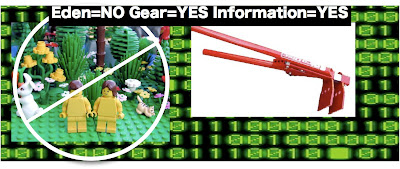
In Judeo-Christian tradition, the first man and woman lived in a place in which no technological solutions were needed, a place with food freely provided and climate appropriate for no use of clothes.

It's a sin to think of the Garden of Eden as a desirable or admirable place. It is stripped of what makes humans special - cognitively generated gear and information that provide survival solutions.

I'm very fastidious when it comes to gear and information. The paradigm of mass marketed dominant brands ( Mall culture ) is not for me, mainly because I find the solutions provide a poor function space for my overall existence. The paradigm of abstinence or less-and-local, whether a Thoreau type of downshifting or militant grown-locally adbusting, is not for me because it is impoverished, self-righteous and not at all healthy.

My highly specific agenda for living has found a perfect meta-tool for life. Google and Amazon. Google ads (with integrated user-targeted news articles) and Amazon recommendations are the only way I want to learn about the gear needed for living. Google monitors almost my entire online life and provides ads relative to my discourse. Amazon provides associative logic on patterns of purchase. With Google and Amazon parsing my online activity, My discourse becomes the gatekeeper/filter for marketing of gear. Gear is good and a sign of a more fully realized human, and with smart ads, the marketing of gear is made good also. Smart advertising combined with long tail economics makes an even more empowering acquisition of goods.

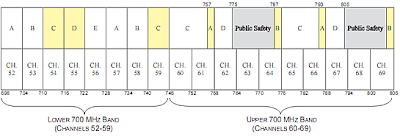
Internet protocol Information travels as electrical pulses called bits. Typically they travel across cables on backbone networks, often one or two satellite hops. Since the 1990's a last mile delivery system of wireless radio signals has become popular, most often in homes or offices as a local area network. With the Federally mandated illegalization of television over the analogue 700Mhz spectrum ( all standard definition TV is now digital, by law ), the internet can be broadcast over old TV signal bands.

This is a new "last mile" delivery solution for information. Remember what makes humans special - cognitively generated gear and information that provide survival solutions. A new last mile delivery of a world wide web of information is a big deal in human progress. Add to that a exponentially more important distinction -the 700Mhz spectrum could be a closed network ( only allowing specific devices, with specific functionalities to access ) or an open network ( you could create your own device, operating system and applications that can access through publicly known standardized protocols ). Google got the FCC to agree that if a certain reserve bid is met, Block C of the 700Mhz spectrum would be mandated as open, no matter who buys it.

As of Jan 31st 2008, with auctioning still going on and winning bidders not known, news emerged that Block C has met that reserve bid threshold, and open access is now mandated. A new step towards more client side economics has been made, in one of the most powerful pieces of property on Earth.

Unmanageable Complexity

January 20, 2008 I wrote a friend with a positive tone about chaos in society:

"Unintended consequences are a good sign, a sign that the society is innovative beyond the pace of its own ethics. In a state of absolute adherence to its ethics it would die or be consumed by an innovative society. Balance can only slightly be achieved in perpetual disequilibrium. Absolute balance means death and entropy, perpetual disequilibrium is life."

I am unrepentant for this celebration of diversity, but will offer this pathology in social dynamics (including internal dialogue which is just a subcomponent of social constructs).

Dishonesty.

Dishonesty creates unmanageable complexity for the deceived.

Tuesday, January 29, 2008

Symbolic analysis of the corporeal world

"Symbolic analysists solve, identify, and broker problems by manipulating symbols. They simplify reality into abstract images that can be rearranged, juggled, experimented with, communicated to other specialists, and then, eventually, transformed back into reality. The manipulations are done with analytic tools, sharpened by experience. These tools may be mathematical algorithms, legal arguments, financial gimmicks, scientific principles, psychological insights about how to persuade or to amuse, systems of induction or deduction, or any other set of techniques for doing conceptual puzzles."
-The Work of Nations, Robert B. Reich, Vintage Books, New York, 1991excerpt

Binding the above to tangible reference points is a means to avoid the cultural failures that occur when metaphysics is the reference point. Metaphysics is by definition impervious to facts, thus making it a pathological course-correcting mechanism in social systems. Cultures whose symbolic analysts are entirely metaphysical ( religious or psychological shamans ) guide the culture into a black hole of lost. Binding the corporeal to symbolic analysis is the distinction of cultures capable of progress or course correction.

All cultures have the corporeal as a reference point in their language, but not all have symbolic analysts who can move massive amounts of the material world by manipulation of symbols (example: mining engineers). Cultures without this mass moving capability are in more of a peer relationship with the biological and geological. This limitation means loss of control on a planet with cultures that use letter/number symbols or electrical-networked bits to move earth, water, air, animals, and people.

The dominance of one of these types over the other type is not rigid nor enduring. Cultures can be amorphous. Symbolic analysis of the corporeal world always dominates and succeeds, and even more so when those formerly not capable of it are encouraged to integrate into the elite skill set user group.

Wednesday, January 23, 2008

Forget the Frankfurt School

"Dialectic of Enlightenment, is the pivotal, fundamental textbook of Freudo-Marxist Critical Theory explaining the socio-psychological status quo that had been responsible for, what the Frankfurt School considered, the failure of the Enlightenment, a defeat represented most dramatically by the events of the Holocaust."
-wikipedia
"Culture industry is a term coined by Theodor Adorno (1903-1969) and Max Horkheimer (1895-1973), who argued that popular culture is akin to a factory producing standardized cultural goods to manipulate the masses into passivity; the easy pleasures available through consumption of popular culture make people docile and content, no matter how difficult their economic circumstances. Adorno and Horkheimer saw this mass-produced culture as a danger to the more difficult high arts. Culture industries may cultivate false needs; that is, needs created and satisfied by capitalism. True needs, in contrast, are freedom, creativity, or genuine happiness. Herbert Marcuse was the first to demarcate true needs from false needs."
-wikipedia

Paleo-hippies rallied around memes that , by their spreading, would weaken the stronghold of mass culture and rational thought.

With those memes a wave of euphoric freedom is expected to be felt, a new perspective in which the magical and unbounded are available. What can be purchased in the capitalist system is then seen as dirty, caged in, tired and ridden with guilt for the lack of stature of the workers at the origin point of the goods.

Magic, creativity and freedom are enabled.

The second class human emerges. One that can be easily owned and manipulated. Disengaged from symbolic analysis of the corporeal world, the magical class are not easily herded from without but will strongly bind to an inner mission statement or religious icon.

In their minds forever the victors of a war with Shakespeare, Plato, Aristotle and any cultural artifact that has an association with the building blocks of the Holocaust. This is the class which suffers recurring defeats in contests with any foe that wields technology powered by symbolic analysis of the corporeal world, but they never perceive themselves as defeated because the use of symbolic analysis of the corporeal world is either beyond the grasp of the lower ranks or taboo for the leaders.

The old joke "Question: Why are so many trees in France? Answer: Because the Germans like to march in the shade" describes the situation for magical and mystical cultures quite well.

Progressive means moving on from caring about this news story. Every day the mystical emerge defeated, with the news that their modus operandi has succeeded once again. All have styles of broadcast for scenes of their martyrdom, and a path for money to follow to reinvigorate their self-image.

Let's spend our money on an iPhone, let's create more wi-fi networks, let's build robots to fight war, let's constantly improve symbolic analysis of the corporeal world.


Monday, January 21, 2008

AI vs AI and the Quantum of the Conversation

This blog post is going to proceed with a fast, bumpy clip. The topics will be:

  1. Reference to a riveting story on dual asynchronous suicides of two pioneers in artificial intelligence.
  2. Where their projects have migrated to after their death.
  3. The Turing Test compared to Shannon's Theory of Information.
  4. Alicebot vs Google. Introducing my phrase :"The Quantum of the Conversation"
  5. My wife's question to me: why is AI so important to you?

Wired magazine has an amazingly well written piece by David Kushner titled Two AI Pioneers. Two Bizarre Suicides. What Really Happened?. Not going to repeat the article here, the article does a better job of representing itself. Everything I write in this blog entry assumes you know their work in AI.

McKinstry's Generic Artificial Consciousness (GAC) [pronounced 'jack"] is incorporated into chatbots at http://www.alicebot.org/. Push's project lives on at http://commons.media.mit.edu:3000. Reflecting the essence of the project goal, the websites are interactive, full duplex communication for the visitor.

Both the Mindpixel and Open Mind projects pursue some nuance of the Turing Test (1950), building a machine which appears totally human (in language only) to a human interviewer.

Claude Shannon's Mathematical Theory of Information (1948) is an earliest stage of a comprehensive understanding of all communication via statistical quantification By using Google, a user is showing an interest in statistical quantification of information, because that is all Google searches provide.

Now for my opinion. I would rather have a conversation with Google than Alicebot. Assuming a chatbot friend is not stupid: the bot knows Nixon did not fear an invasion of Visigoths, that leaders in another point in history did worry about Visigoths, and that there are no outdoor alligator farms in Greenland. Still, it is just a single human friend. With Google I get to have a conversation with a real time world information filtering device. WORLD, dear brothers, sisters and chatbots. A chatbot stands in that mode humans usually stand in, socializing. Socialization helps normalize us to be within bounds of behavior and opinion. With a chatbot, just as with single human friends, your normalization is shaped by the quantum itself, which is small and intimate. With Google, your normalization is with an entity much larger than human.

The quantum of the conversation is analogous to the standalone computer versus internet-as-computer dichotomy. Older computer programs were written to happen entirely on one computer, whereas cloud computing programming utilizes multiple computers and usually has access to the whole internet. By another analogy, the Turing Test is flatearth, and a non-human-giant-AI is copernican.

Last night, my wife asked me; "Why is AI so important to you?". My answer: Because of the quantum of our problem domain. All questions, including the most metaphysical or philosophical, have become too complex for humans to understand by talking to more humans. Historically, when we've realized we needed information beyond what other humans could provide we turned to Earth gods or Sky gods. Now the 7th Kingdom of Life, Technology, has grown to measuring all information and giving meta reports, which recursively change the information set. Humans able to get in on that conversation are part of something amazingly powerful. Powerful on a scale with the advent of prayer and community.


Supporting and supplemental documents:

Sunday, January 20, 2008

Naivete: The Essential Fuel for War

Frontlines: Fuel for War is a new video game that is about one thing: A world war in 2030 fought for the last supplies of oil.

In a CNN Money article "Peak oil: The video game" there is the usual marketing-hype-as-news. What is more pathetic than the free advertising came from the the sole academic in the news story.

"They could in fact lead to changes in attitudes, beliefs, and ultimately, changes in behavior," said Craig Anderson, a professor of psychology at Iowa State University who studies the effects of video games on people.

"It may well change attitudes towards the use of these tactics as a political tool," he said. Players may think "of course we have to use military tactics to go take oil."

Is Craig Anderson an adult? I mean the kind that can vote, pay their own rent, watch a movie with some sense of timeline coherence? His multi-faceted confusion about politics concerns me, and I find it strange he is deemed an expert/gatekeeper on the effects of games on our psychology, and politics. He doesn't even have the meaning of politics in his head.

In the the early 1990's war between the US and Iraq that took place in Kuwait, President Bush mentioned oil resources as a reason for war in a general public speech. This is one of many public utterances regarding military tactics to take resources. But this acknowledgment of a long history in which politicians talk about war for resources misses a major overarching semantic distinction:

Politics is the process by which humans decide the allocation of resources, with war and trading as fundamental and eternal subcomponents of the term itself.

Not knowing the above is appropriate for someone that never visits a voting booth.

Knowing the meaning of politics and agreeing with the narrative assumptions in a game such as Fuel for War are two different things. e.g. Believing we should both 1) Develop other means of powering industrialized society 2) Find more cooperative ways to negotiate and pay for oil resources. I am thoroughly in that camp. Fuel for War has America fighting China and Russia. Such an uncool scenario to me.

But I wouldn't be thinking it is "uncool" if I had the mind Craig Anderson assumes I have. I wouldn't know the problem domain at all.

Saturday, January 19, 2008

21st Century Public Safety

In a previous blog entry, Towards less Hate: Rise of the Bourgeoise-Technologist, I show a typing of social/economic dependence. Please see that blog entry in order to understand what follows.

Racially and religiously homogenous groups have ancient means of self-governance. They fall into my Type 1 category. Policing is performed by the familial -mothers, fathers, friends. "It takes a village" sums it up.

Type 2 stage is less coherent and efficient for public safety if policing has moved to non-local and non-familial, while the local node is still as racist, religiously sectarian, or harbors a nationalist agenda serving their race or religion. The LA riots of the 1990's, riots in Muslim neighborhoods of France, and religious compound raids such as the Waco Texas Branch Davidians are examples. In all these cases the local racist or sectarian node does not tolerate non-familial ambivalent policing.

A Bourgeoisie-Technologist class, Type 3, are a return to coherence and efficiency in the realm of public-safety. With the ancient form of familial social governance diminished almost to zero, and opposition to racist or sectarian agendas due to these being an economic suppressant; the Type 3 Bourgeoisie-Technologist class stands to gain more public-safety in an age of ambivalent technological social control.

With every surveillance camera and RFID tag the Bourgeoisie-Technologist class can expect greater safety. Of course Type 1 and 2 societies will see the same technologies as threatening their racist or sectarian strongholds, and especially threatening their use of violence on outsiders. For the more fluid individuals without strong allegiance to race or sect, but serving themselves through violence or illegal economics, the surveillance is a straightforward threat.

The Bourgeoise-Technologist class can make increased public-safety more likely by practicing a non-solidarity with Type 1 and 2 classes. The check point, query from police officers, or survey by video camera is an entirely different experience for the legal and illegal. A safe environment for the Bourgeoisie-Technologist class is one with these policing methods 24/7.

A word should be said about wealth and inclusiveness. Our standard view of the 1950's as a bourgeoise paradise, and repressive for minorities; helps foster a negative connotation of the term bourgeoise. That "bourgeoise paradise" of the 1950's was Type 2-an antithesis of the Bourgeoise-Technologist class. The cost of equipment needed for entrance in the Bourgeoisie-Technologist class is well below $500, and there is no one at the entrance door checking for specific race or religion. As far as hurdles to enter an upper class go, the < $500 is a doable one. Then there is the issue of public safety. Historically the underclass have a life threatening hurdle before they can enter a higher class, and it is called "street violence". Peaceful members of the underclass could more likely muster the $500 for upward mobility if they could safely go about their business. Every surveillance camera helps the underclass have less harassment from their own.

The poor want public safety also, for immediate peace, and for an environment conducive to entrance in the Bourgeoisie-Technologist class.


Supporting and related material:
Coplink Artificial Intelligence

Towards less Hate: Rise of the Bourgeoise-Technologist


Type 1: Symbiotic dependence is entirely local. If there is a more global connection and trade, it is created by an elite class equipped with mobility and communications, involved with locals only to exploit natural commodities of labor, minerals, plant or animal extracts, or entertainment talent.


Type 2: People we are symbiotically dependent on are local, plus political leverage through homogeny by solidarity with racial or culturally similar groups. Coordination between local nodes is facilitated by one-to-many media. The media has certain command capabilities, and locals have leverage in the form of only watching affirmation of their cultural or racial biases. This social type is still strongly Type 1.

Examples: 50's and 60's WASP-centric programming, Black Entertainment Television channel, TV evangelism.


Type 3: A growing class symbiotically dependent on a global economy. These are non-elite equipped with mobility and communications, untethered to local circumstances of others, and symbiotically dependent on people not in their racial, religious, or national profile.

My term for this antithesis class to the Type 1 and 2 profiles: Bourgeoisie-Technologist.

Bourgeoisie-Technologist Flag

Dialectics on Types 1, 2 and 3

A rise of a Bourgeoisie-Technologist class does not equate to anticipation of total peace, nor does it imply that the Internet will disable Type 1 and 2. The Internet will aid in perpetuating 1) the exploitation of locals by malicious elite. 2) Affirming old racial and cultural homogeny's and prejudices by giving "channels" for viewers to watch their beliefs affirmed. The Bourgeoisie-Technologist class owes its existence to mobile phones, computers, and satellite data transmission; but the Internet is a wider phenomenon. Perhaps this illuminates the stereotype of iPhone user as a diversity-friendly type, and large PC users as more Type 2-ish.

Friday, January 18, 2008

Bottom Up Workplace Productivity

Below is generalized copy of an email I sent to all employees in my company, and has gotten a very positive response from the CEO and workers. The seeds of it are a political framework summed up in one line of the email: All great societies become that way because the little guy wants to do better than their bosses asked.
Bosses = Authority figures of any kind.


BEGIN EMAIL

All,

I would like to propose a [COMPANY NAME] BottomUp Productive Workplace Group.

The concept is well documented and formulated in academia and in writings on the web. I'll be happy to show examples at another time, but prefer to keep it short here.

This group would be all the non-managers at [COMPANY NAME] who want to join in. Not sure how often people would want to meet, and the most likely time slot would be when we are off the clock but conveniently around each other -which is lunch time.

To cut to the chase, here is list of what I believe it should be, and not be:

  • NO:
    1. Aimless complaining.
    2. Aimless bad mouthing managers or anyone at [COMPANY NAME].
    3. Chatter about hobbies unless those hobbies have a roundabout connection to [COMPANY NAME] culture or business.
  • YES:
    1. Visions for how we can do directives from managers better, faster or easier. Note that this is opposite of "revolution" or other forms of disobedience. All great societies become that way because the little guy wants to do better than their bosses asked.

    2. Focused criticism of a given SOP, with a mandatory "better idea" that one can offer. The person offering such ideas needs to point out some practical details, not just unfocused day dreaming.

    3. Fun ideas about anything creative for [COMPANY NAME]. What should we invent? What the booth should look like at the big demo? If we as group think an idea is especially shiny, we can present it formally to [CEO and CTO]. It is not expected that our ideas will be usable by [COMPANY NAME], but there is always the chance. ( This is how some of Googles best products have happened, with employees creating on personal projects. Google awards one million dollars to teams that create such new ideas.)

Perhaps it would help telling why I thought of this. First, a good bit of my schooling was in this. Second, this week there was a management meeting. I noted those not in attendance, and they are a valuable resource within [COMPANY NAME]. Said another way: [COMPANY NAME] has an abundance of people with interesting perspectives, useful skills, and intelligence. I guarantee all of you [CEO and CTO] want to make as much money as possible (as I do also). Once they see non-management providing more profit through greater efficiency, quality, and general smartness; they will be receptive and acknowledge your contributions.


END EMAIL

Tuesday, January 15, 2008

Long Tail Economics

In the 1980's and 90's news columnists and political-economics activists focused on the threat to Mom&Pop stores ( the archetypical Jim and Betty's Hardware Store) that Wal-Mart was posing. No doubt, the rise of Wal-Mart and the big box stores did lead to the disappearance of small or individually owned stores in suburban or small town USA.

The activists may have had hearts of gold, wanting Jim and Betty's Hardware Store to survive, and along with it the community spaces that usually formed ad hoc in these old and less formulaic establishments. But that's not what people wanted. The big box stores sold the generic stuff at the cheapest prices. For poor or middle class people, that formula is going to almost always win.

Now, there has been another revolution, maybe more fundamental than the rise of big box stores. The key is the breaking of the generic+cheapest formula, by subtracting the generic and "most popular" items. It is called Long Tail Economics, named after the "long tail" of the graph at the top of this post.

Imagine a brick and mortar book or video store, such as your town's big Border's Bookstore. This store stocks the 160,000 most popular books. Great for them, and for all of us living within driving distance that want one of those books. Here is where sellers with no store on Earth, such as Amazon.com or Netflix.com, crush that reality. They make more money selling millions of copies of the least popular titles on Earth.

Society is not going back to shopping at Jim and Betty's Hardware Store, they are closed. We will still need big bags of Dorito's, 2 liter Coca-Cola's, screwdrivers and office supplies -so the Costco's and Wal-Mart's are needed on a weekly basis. What is needed on a permanent basis is access to the almost bottomless pit of obscure micro-industries, spin-off C-grade rip-offs of subculture cult favorites, and ancient goods such as stone tools.

Thank god we have internet online commerce, without which we would only have stores with Doritos, Coca-Cola, and office supplies.

Who are the people selling in the new paradigm? Here are two excellent examples:

Very Scary Carnival is an artist who I've known since 1982. She has sold art in various media for decades, and now has lots of fun stuff at Zazzle.com.

Another grand example of hyper-obscurity is my tiny presence on iTunes as a music artist. Click here to be taken to my place in the store. To have a listen to different music by me for free go here.

Some have thought that the paradigmatic decline of big-box Doritos outlets would be the local food co-op. While living in Olympia, I saw the local co-op, with its under-caffeinated staff selling nothing useful. The photo to the left is about all they had. I'll take Doritos, specialized FOSS capable electronics, and obscure art over that any day.


Robert Putnam's book Better Together has as title of one chapter: Craigslist.org: Is Virtual Community Real?. The case study marks the online phenomenon as positive in many ways, but fails to fully qualify it as building social capital. This is mostly due to the Putnam social capital thesis demanding a high degree of corporeal associativity (basically you need to hang out with the group on a frequent basis). Here is where the revolution flips: asynchronous associativity provided by ambivalent machines performing algorithms. The associations are not just about about long tail economics (customers that bought this also bought that), rather every social domain, especially politics, are being supported in this asynchronous virtual world. Of course the old fashioned form of meeting people in real time is always in fashion, but to say it is a higher form of social capital is academically arbitrary and out of sync with the trajectory of folk empowerment. This localism stance socially and civically disables anyone who strictly obeys the orthodoxy.

Monday, January 14, 2008

Me: The Mutation

This blog posting may appear as 100 per cent indulgent. I am going to talk about what I like. But the idea is not to propagate readers -you are not being asked to be like me. The focus is on two axioms:

  1. No one is entirely alone in their preferences and methodologies. If I prefer, contemplate, or do something, there are others doing the same.
  2. Humans have been evolving in very separate ways, grouped by continents (influenced by unique climates and landscape), and even more so in the last 5,000 years with culture (not nature) being the filter for surviving mutations.

These axioms are the a priori assumptions to keep in mind as you look at

Me: The Mutation: My Ambient Environments:


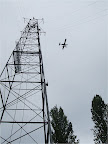
ice, mountains, and technology

rock and ice topped mountains

concrete bridges

power and communication towers

high population density
(city)

high population density
(remote village)

high altitude, treeless plains

big city urban core

command line interface

data link to globe

buckethead types of music

caffeine

surveillance

long tail economics

The point of listing these cognitive artifacts/biota is to press for their antithesis -all the types which do not fit on the list. Now think of all the humans that function at optimum on the antithesis list.

Those humans are of a different evolutionary track. We are genetically different.

Supporting and supplemental documentation:
The neural bases of complex tool use in humans

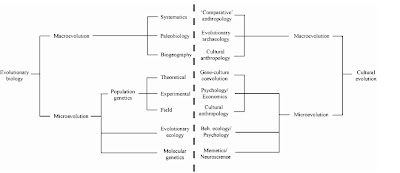
Mesoudi, A., Whiten, A., & Laland, K. N. (2006). Towards a Unified Science of Cultural Evolution. Behav Brain Sci, 29(4), 329-347; discussion 347-383
Human-Computer Interaction: Cognitive Science, Memes and Evolution.
21st Century Public Safety

Buckethead video.

Long tail economics theory.

Thursday, January 10, 2008

The Giant AI Series: The Text Machine


Supporting and supplemental documents:
http://www.edge.org/q2008/q08_11.html#oreilly

Stewart Brand: On what he changed his mind about.

Stewart Brand Founder, Whole Earth Catalog, cofounder; The Well; cofounder, Global Business Network; Author, How Buildings Learn.

He was asked "What things did you change your mind about in 2007?

Answer: Good Old Stuff Sucks. See the full text here.

The question, and Mr. Brand's answer, were part of survey question addressed to a large of what I would ( with high respect ) call celebrity intellectuals. These are people with years of investment in their ideas. their "ideology". Their bills get paid because people pay to hear their ideas. So, for them to change their minds, and admit it in a public forum, is an honest sort of courage.

I think those of us who are not celebrity intellectuals could use the same dose of courage. Whoever we are -committed environmentalist, Christian Coalition fundraiser, gay rights activist, anarchist, or police officer; that identity may pay our bills or gain us popularity but will dry up the more nimble parts of our brain and our hearts if left unchanged forever. No one is asking us to go work for the bad guys, whoever that is, but maybe the fresh vantage point gained from a changed mind will help you serve the good guys a little better.

Wednesday, January 9, 2008

The Giant AI Series: Technology is the 7th Kingdom of Life

The Giant AI Series: The Integration

In the 1960's a German philosopher wrote:
“Eventually the system will reach a point–the word that provides the social cue is ‘integration’–where the universal dependence of all moments on all other moments makes the talk of causality obsolete. It is idle to search for what might have been a cause within a monolithic society. Only that society itself remains the cause.”

( Negative Dialectics, p. 267, Adorno). Amazon.com

There are many postulating a rise of technology that makes technology, and has political leverage with humans. Could Adorno's "total integration" be an antecedent of the rise of technology as political peer? Nature was an ambient condition for the rise of culture, could culture that has lost its reference to outside causality be an ambient for the rise of technological life?

This progressive hopes so.

Monday, January 7, 2008

The Arc of Activity called Humanity, and Antithesis

One great arc through humanity's whole existence has been towards ever more mobility, distance from biological governance, and symbolic analysis.

No legislation can undo this iron law. No religion can control this through ethical constraints. To be human is to try to move to the next hyper-stage of mobility/anti-biology/symbolic-processing without all other humans following the same uptake.

This creates stratifications. Stratifications to the point of enslaving those who have not equally graduated to the upper limits of the arc -these stratifications are not wrong but the enslavement is.

Equality of all ways of being or equality of opportunity? That is the question that divides many progressives. My stance: Equating every strata as equal with the current upper limits of mobility/anti-biology/symbolic-processing is a mistake, a lie, and nothing to do with social justice. Being progressive is allowing all to move towards the upper limits of mobility/anti-biology/symbolic-processing.

One is not an equal within humanity's upper limits of mobility/anti-biology/symbolic-processing until one participates in its creation and maintenance.

Those who permanently oppose, or fundamentally abstain from, the upper limits of this "Arc of Human Activity" generate a unique class in the "Arc of Human Activity". An antithetical arc to the larger human enterprise, historically this class began as religious aesthetics in various cultures after the great migrations of 800 BC. Today the antithetical arc has matured, enabled by cheap, ubiquitous lethal technology and distributed informational warfare; resulting in a formidable religious aesthetic militancy.

The religious aesthetic militants, whether propagandists or violence professionals, benefit from cognitive dissonance -they oppose the classes and cultures representative of the current upper limits of mobility/anti-biology/symbolic-processing; and also use every last shred of those culture's industrial output artifacts in inventive ways to wage their opposition. This is not new, the Middle Ages had even more of this phenomenon present in wars that spanned out from Central Asia. What is new is the lethality of our portable and affordable technologies.

"The Arc of Activity called Humanity" is not going to cease, and the antithesis is always going to have practitioners. It will be interesting to see the mutations and adaptations humans are forced into through this great war of the Arc and Antithesis. Ironically, the religious aesthetic militants may push human evolution (through cultural induced evolution) to a more permanent and mechanical class difference.

We'll see.


Forget the Frankfurt School (a compatible writing, more accessible terminology and developed critique.)
Supporting and supplemental documents:
Terraforming War

Saturday, January 5, 2008

United States President: An Innovation

For an end to the culture war, and to move to a more collaborative and efficient union, America needs one of these scenarios for the Executive Branch:

Obama/Huckabee

Huckabee/Obama

Bloomberg/Schwarzenegger

Schwarzenegger/Bloomberg

I am an inner-city liberal that has no car, secular and geekish. My lifestyle would put me in the left-liberal camp under the old rules of the culture war. But I'm really tired of one side winning 4 years and shoving their collective lifestyle tenets down the throat of the other culture. All the guys in my list above are beyond such liberal-conservative war mongering. Defying old stereotypes -Huckabee is a former preacher that is also hip and witty, Obama is hip and also religious. Bloomberg and Schwarzenegger are Republicans that have championed progressive environmental policies, out of sync with many in their own party. They all know the collective economic muscle of this country relies on cities and countryside, religious people and geeks, hipsters and oldsters. To choose one or the other is to choose a weak country.

I select All the Above.

Idealistic Autopoiesis

The idealist's autopoiesis postulate is quite out of control in the last couple of decades. With cultish religious groups funding psuedo-populist projects such as the What the Bleep movie, we now have a whole subculture that has self-propagated their own affirmation of the postulate.

This is nicely recursive, a subculture auto-creating their own epistemology, but as an example it shows the weakness in the subculture itself and autopoiesis as an entity's modus operandi.

While posing as avant garde, the autopoiesis cults commit a strange error. The language is very stong in platonism and individualism, two things the cults typically vilify. e.g. Entity X is existing, knowing its X-ness, and imposing its continued X-ness in the next moments of the universe.

As much as the autopoiesis cults talk about complexity/chaos/transitory states, the X in Universe phraseology is flat-earthish.

A richer view of the universe would have a "critical mass" appended to the X in Universe construct. And this view is not so woo-woo as to generate an inarticulate awe. We should be able to say 1,000,000,000 X's, self aware and wanting to perpetuate their lifestyle, are living in the Universe.

For an excellent example of this view, look at any old classic book written about city life. Whether the city is Beijing, New York, or Calcutta -the prose needed to represent such a complex phenomenon usually acknowledges a critical mass complexity.

I guess I'm wanting to shake up the Realist vs Idealist dichotomy, and say there should be a Realist vs Idealist dichotomy on atomic levels language constructs, but a more mature construct is an Emergence view that avoids the traps of these camps. Emergence would focus on consequences more than reductionistic causation questions. Watching for bifurcations in phases of critical mass of X's.

Thats where the action is.

originally posted on craigslist/philosophy